
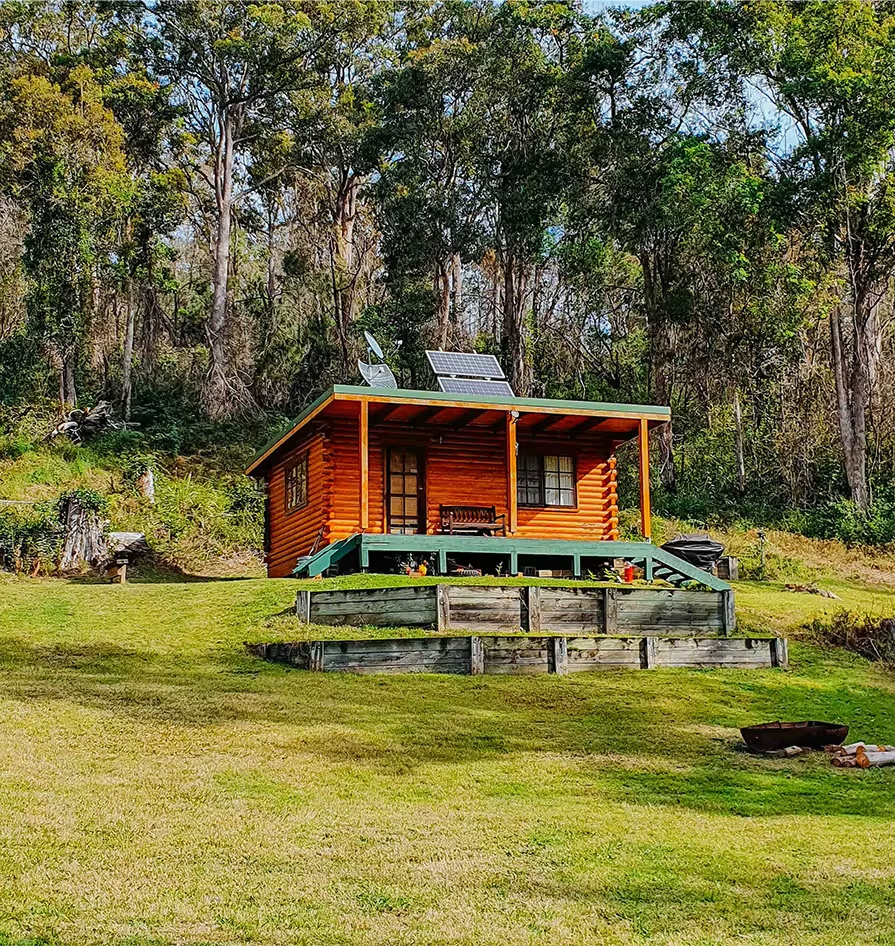
Batemans Bay and the surrounding South Coast has a genuine off-grid market — coastal bush blocks, acreage properties, and cabins where running a grid connection would cost more than the system itself. It's one of Island Solar's service areas for exactly this reason, alongside our core Canberra/Queanbeyan territory. We've since extended that off-grid work further along the coast too — see our Bega, Ulladulla & Merimbula guide if you're outside the immediate Batemans Bay area.
Off-grid vs. grid-connect with a battery
These two get conflated constantly, so it's worth being precise:
| Grid-connect + battery | Genuinely off-grid | |
|---|---|---|
| Grid connection | Yes — battery supplements, grid is the fallback | None — no fallback if the system runs short |
| Battery sizing | Sized for daily bill savings | Sized for multi-day autonomy (cloudy runs) |
| Feed-in tariff | Yes, for excess export | Not applicable — nowhere to export to |
| Typical use case | Suburban/urban homes wanting lower bills | Remote or costly-to-connect properties |
If you're comparing costs, our battery storage guide covers the grid-connect case in detail — this guide is specifically about the standalone, no-fallback setup.
Why off-grid costs more per kW than grid-connect solar
Unlike our grid-connect pricing, which we quote off a consistent $824/kW + $429/kWh rate, off-grid systems don't compress neatly into a per-unit number — every off-grid job we've costed varies too much on a few factors to fairly quote that way:
- Multi-day autonomy. With no grid fallback, the battery bank has to cover several overcast days, not just overnight — that's a much larger battery than a grid-connect system needs.
- Conservative sizing. Off-grid systems are sized against your worst realistic week, not an average day, which pushes panel and inverter capacity up.
- Backup generation. Many off-grid setups include a backup generator for extended low-sun periods, adding cost but avoiding an oversized (and expensive) battery bank.
- Site-specific electrical work. Remote properties often need more cabling, earthing and switchboard work than a standard suburban install.
Typical range for a complete residential off-grid system in our service area — the honest answer is "it depends," and we'd rather quote you a real number after a site visit than a fabricated per-kW rate that doesn't hold up. Contact us for a tailored quote.
Who off-grid genuinely suits
- Properties where a grid connection quote comes back more expensive than the solar system itself — common on rural South Coast blocks.
- Cabins, shacks and secondary dwellings used seasonally, where you're not paying daily supply charges for a connection you barely use.
- Owners who want genuine energy independence, separate from the cost case.
It generally doesn't suit a household expecting town-house levels of unlimited, unmonitored power use — off-grid living means being somewhat mindful of big loads (like running the dryer on a cloudy day), especially without a backup generator.
What a proper off-grid quote involves
- Load audit. We go through every appliance and its realistic daily/seasonal usage — this drives the whole design, not a rule of thumb.
- Site assessment. Shading, orientation, and where the battery/inverter shed will sit.
- System design. Panel array, battery bank and (if included) generator sized to your worst-case week, not an average one.
- Fixed quote. A real number for your property, not a generic range.
Equipment considerations that differ from grid-connect
The hardware in a genuinely off-grid system does more work than its grid-connect equivalent, and a few components deserve extra attention when you're comparing quotes:
- Battery chemistry and depth of discharge. Off-grid banks are cycled harder and need to tolerate deeper, more frequent discharges than a grid-connect battery that's mostly topping up daily bill savings — this affects both the usable capacity you're actually paying for and the expected service life.
- Inverter/charger sizing. An off-grid inverter has to handle 100% of your household load with no grid to lean on during a peak draw (kettle, power tools and the fridge compressor kicking in together, for example), so it's sized against your peak simultaneous load, not your average.
- Charge controller quality. This is what actually protects the battery bank from over- or under-charging — it's a smaller line item than panels or batteries but a poor one shortens the life of the expensive parts of the system.
- Generator integration (if included). A generator that's properly integrated with the inverter/charger can auto-start during an extended low-sun stretch and top the battery bank up efficiently; a poorly integrated one just adds noise and fuel cost without solving the underlying autonomy gap.
Ongoing maintenance and monitoring
A grid-connect system is largely "install and forget" — the grid quietly absorbs any mismatch between generation and use. Off-grid doesn't have that safety net, so a bit more ongoing attention pays off:
- Monitoring. Knowing your battery state of charge and daily generation lets you make small behavioural adjustments (run the washing machine at midday, not after dinner) before a cloudy run becomes a real problem.
- Panel cleanliness. Coastal and rural South Coast sites can pick up salt spray or dust faster than a suburban roof — a periodic clean protects the generation margin you're relying on.
- Generator servicing (if fitted). Treated like any other small engine — regular servicing so it's actually reliable on the one week a year you genuinely need it.
- Seasonal load planning. Solar generation and usage patterns both shift with the seasons; South Coast winters mean less generation and often more heating load at the same time, which is exactly the scenario the system needs to be sized against, not the sunny-day best case.
Common off-grid questions
How many cloudy days can a properly sized system handle? This is precisely what the load audit and "worst realistic week" sizing approach is for — there's no universal number, because it depends on your actual daily usage and the battery/generator combination we design for your property.
What happens if the battery genuinely runs low? A well-designed system either falls back to a generator automatically or gives you clear, early warning via monitoring so you can reduce load before it becomes a real shortage — this is a design question worth asking any installer directly.
Can I start smaller and expand later? Sometimes, but off-grid systems are more tightly matched to their inverter and battery bank than grid-connect systems, so staged expansion needs to be planned for at the design stage, not bolted on as an afterthought.
Do I still need a generator if I have a big battery? Not always — it's a genuine trade-off between generator cost/noise and a larger, more expensive battery bank. We'll model both options against your load audit rather than assume one is automatically right.
Considering off-grid near Batemans Bay?
We'll do a proper load audit and site assessment before quoting a real number for your property.