
Most of what we've written about off-grid solar has been about the coast — our Batemans Bay guide and the Bega, Ulladulla and Merimbula guide both deal with salt air, coastal bushland and cabins on blocks a long way from the nearest pole.
Inland is not the same job. Cooma and the Monaro sit at real elevation, Yass and the Southern Tablelands get hard frosts most of winter, and Gundagai and the South West Slopes run properties with pumps, sheds and irrigation attached. The core off-grid engineering — a load audit, worst-realistic-week sizing, a properly integrated inverter and battery — is identical. Nearly everything that surrounds it changes.
Cold is the defining design constraint inland
This is the single biggest difference from our coastal off-grid work, and it cuts both ways.
- Cold panels actually generate better. Photovoltaic output improves as cell temperature drops, so a clear, cold Monaro winter day is genuinely good generating weather. The problem inland is never the temperature — it's the shorter day and the lower sun angle.
- Batteries are the opposite. Lithium batteries are the temperature-sensitive component, and many will restrict or refuse charging at or near freezing unless the enclosure is heated or otherwise temperature-managed. On a Cooma property this is not a footnote — ask any installer directly how your specific battery behaves below zero and what the enclosure does about it.
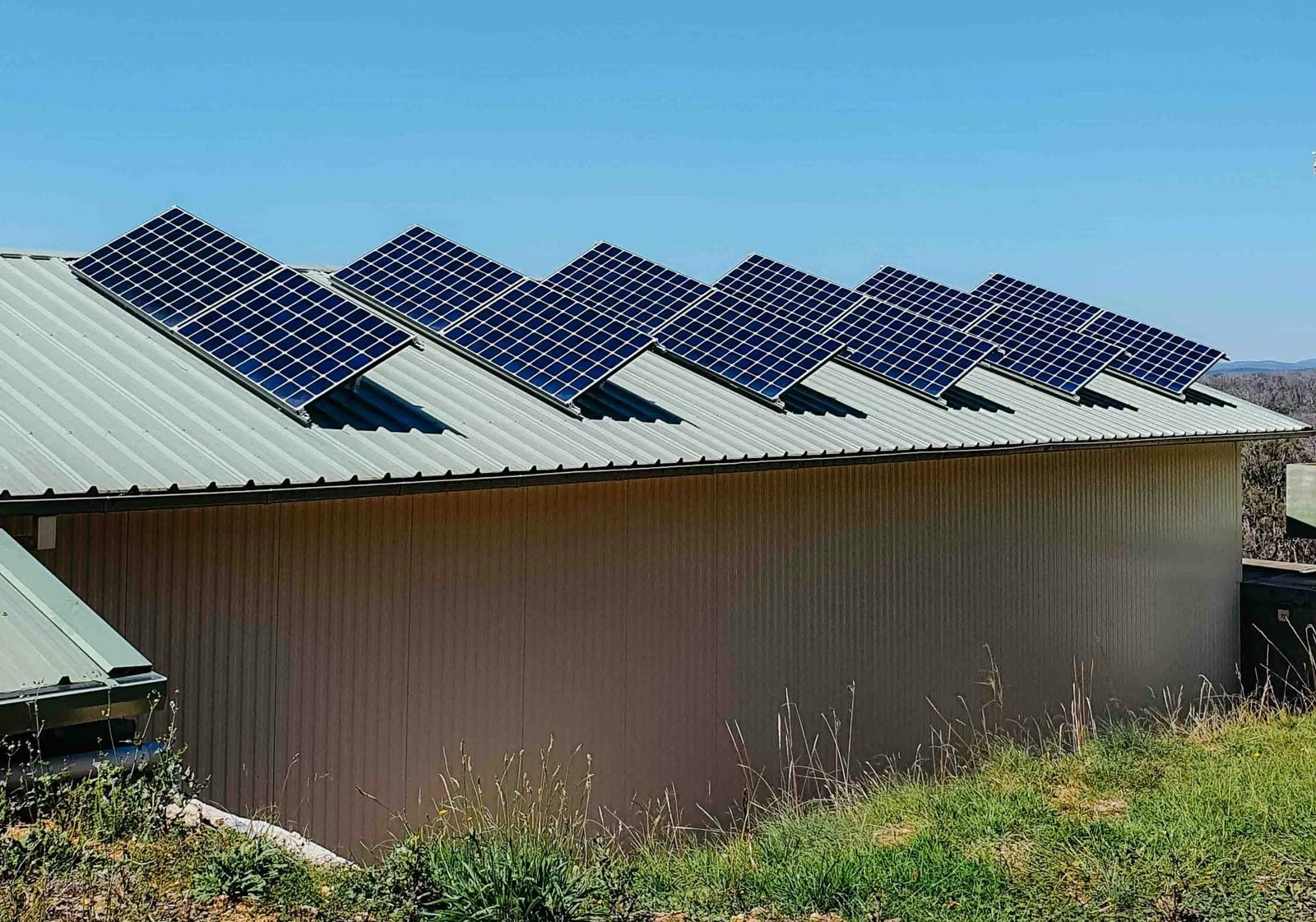
- Frost and snow load on the array. The Monaro and the Snowy foothills see genuine snow; Yass and Gundagai see hard frost far more often than settled snow. Either way, mounting has to be specified for the loads it will actually see, and array tilt matters more inland than on the coast — a steeper tilt sheds snow, catches a lower winter sun better, and costs you very little in summer.
- Generators need to start in the cold. If your design includes a backup generator, its job is to run on the worst week of the year, which inland is also the coldest. Cold-start reliability and servicing discipline matter more here than they do at Batemans Bay.
The winter trough is deeper — and your load peaks at the same time
Our savings calculator uses 1,350 kWh per kW per year as a Canberra and south-east NSW average — that's an annual average across the region, not a figure for any one town, and it is not evenly spread through the year. Off-grid systems aren't sized on annual averages anyway; they're sized on your worst realistic week.
Inland, that worst week is a run of short, overcast winter days when the house is also drawing its heaviest heating load. Coastal properties get a milder version of the same squeeze. This is why inland off-grid systems tend to land on a larger array, more battery, or an accepted generator run than a coastal system serving an identical household — and it's why remote sizing goes wrong here more often than it does on the coast. If you want to get a feel for it before you talk to anyone, our off-grid sizing calculator works from your actual appliance list rather than a rule of thumb.
Farm and acreage loads change the inverter, not just the battery
The properties that search for off-grid solar around Gundagai and Yass are more often working land than weekenders. That changes the electrical brief:
- Bore and pressure pumps draw a large surge on start-up. An off-grid inverter has to carry that surge with no grid behind it, so it's sized against peak simultaneous load, not average consumption.
- Sheds and workshops add welders, compressors and three-phase equipment — worth flagging at the load-audit stage rather than discovering after commissioning.
- Long cable runs. A house, a shed and a pump spread across a paddock means voltage-drop calculations and cabling costs that a suburban install never incurs.
- Seasonal load swings. Irrigation over summer against heating over winter can produce two quite different demand profiles, and the system has to survive both.
Off-grid vs. grid-connect with a battery
Same distinction we make on the coast, worth repeating because the two get conflated constantly:
| Grid-connect + battery | Genuinely off-grid | |
|---|---|---|
| Grid connection | Yes — battery supplements, grid is the fallback | None — no fallback if the system runs short |
| Battery sizing | Sized for daily bill savings | Sized for multi-day autonomy (cloudy runs) |
| Feed-in tariff | Yes, for excess export | Not applicable — nowhere to export to |
| Typical use case | Homes on a connection wanting lower bills | Remote or costly-to-connect properties |
If your inland property already has a connection at the boundary, going standalone is usually the wrong call on cost alone. The off-grid case gets strong when the connection itself is the expensive part.
What it costs
Off-grid systems don't compress into a clean per-unit rate the way our grid-connect work does. Our on-grid pricing is fitted from our own completed jobs and holds up well — $824 per kW of PV plus $429 per kWh of battery, which is what drives our savings calculator. Off-grid genuinely doesn't behave that way, so we don't pretend it does.
Typical range for a complete residential off-grid system across our service area, inland southern NSW included. We'd rather quote a real number after a site visit than publish a per-kW rate that doesn't survive contact with an actual property. Contact us for a tailored quote.
What pushes an inland system up or down that range:
- Autonomy target. How many consecutive low-sun days the bank has to cover before the generator (or a compromise) is needed.
- Generator or no generator. Fuel and servicing cost traded against an oversized and expensive battery bank.
- Peak simultaneous load. The pump-and-workshop problem above — it sizes the inverter.
- Site electrical work. Cable runs, earthing and switchboard work across a rural property, which inland is frequently the line item people don't expect.
Who off-grid genuinely suits inland
- Properties where the quoted grid connection costs more than the solar system — the classic case on Monaro and South West Slopes blocks a long way from the nearest pole.
- Working properties already running generators for a pump or shed, where a properly designed system replaces the fuel bill rather than adding to it.
- Seasonally used dwellings where daily supply charges on a connection you barely use don't stack up.
- Owners who want genuine independence, separate from the cost case.
It suits a household expecting unlimited, unmonitored consumption rather less. Off-grid living inland means being deliberate about big loads during a cold cloudy run — that's the trade, and it's better understood before the system is designed than after.
What a proper off-grid quote involves
- Load audit. Every appliance, pump and shed circuit, with realistic daily and seasonal usage. This drives the design.
- Site assessment. Shading, orientation, tilt for winter sun and snow shedding, cable runs, and where the battery and inverter will live.
- System design. Array, battery bank, inverter and any generator sized against your worst realistic week, not an average one.
- Fixed quote. A real number for your property.
The load audit and site assessment need a physical visit. That's true everywhere, but the margin for error inland is smaller — an undersized bank on the coast means an uncomfortable few days, and on the Monaro in July it means a genuine problem. Because Cooma, Yass and Gundagai sit in three different directions from our Crestwood base, we group site visits by area rather than driving out for a single property. Tell us your locality when you enquire and we'll give you a realistic timeframe for the next run through your area rather than a vague "someone will be in touch."
Ongoing maintenance inland
- Monitoring. Watching state of charge lets you adjust behaviour before a cold cloudy run becomes a problem, and it's the single most useful habit off-grid owners develop.
- Panel cleanliness. Salt spray is the coastal problem; inland it's dust, pollen and paddock grime through summer, plus whatever a dry westerly deposits.
- Generator servicing. Regular servicing so it's actually reliable on the one week a year you need it — and that week is cold.
- Seasonal planning. Winter is when generation is lowest and heating load is highest, simultaneously. Plan around it rather than being surprised by it.
Common questions
Do you actually get out to Cooma, Yass and Gundagai? Yes. We're based at Crestwood near Queanbeyan and we service NSW and the ACT broadly, not just the towns named in our older posts. We batch site visits by area, so timing depends on your locality — ask when you enquire.
Will snow damage the array? Correctly specified mounting handles the loads it's designed for, and a steeper tilt helps snow slide rather than sit. The design question worth asking is what tilt and mounting spec your quote assumes, because a spec pulled from a coastal install isn't automatically right on the Monaro.
Is my battery going to work in a Cooma winter? It depends entirely on the battery and its enclosure. Charging behaviour near and below freezing varies between products, so ask the specific question about the specific battery you're being quoted rather than accepting a general reassurance.
Do rebates apply to an off-grid system? Rebate and certificate eligibility depends on the scheme rules and on how the system is installed, and those rules change — so we confirm what applies to your design as part of your quote rather than quoting a number here that may be out of date by the time you read it. Our rebates and STCs guide explains how the schemes work in general terms.
Can I start smaller and expand later? Sometimes, but off-grid systems are tightly matched to their inverter and battery bank, so staged expansion has to be planned at the design stage rather than bolted on afterwards.
Considering off-grid around Cooma, Yass or Gundagai?
We'll do a proper load audit and site assessment before quoting a real number for your property.