
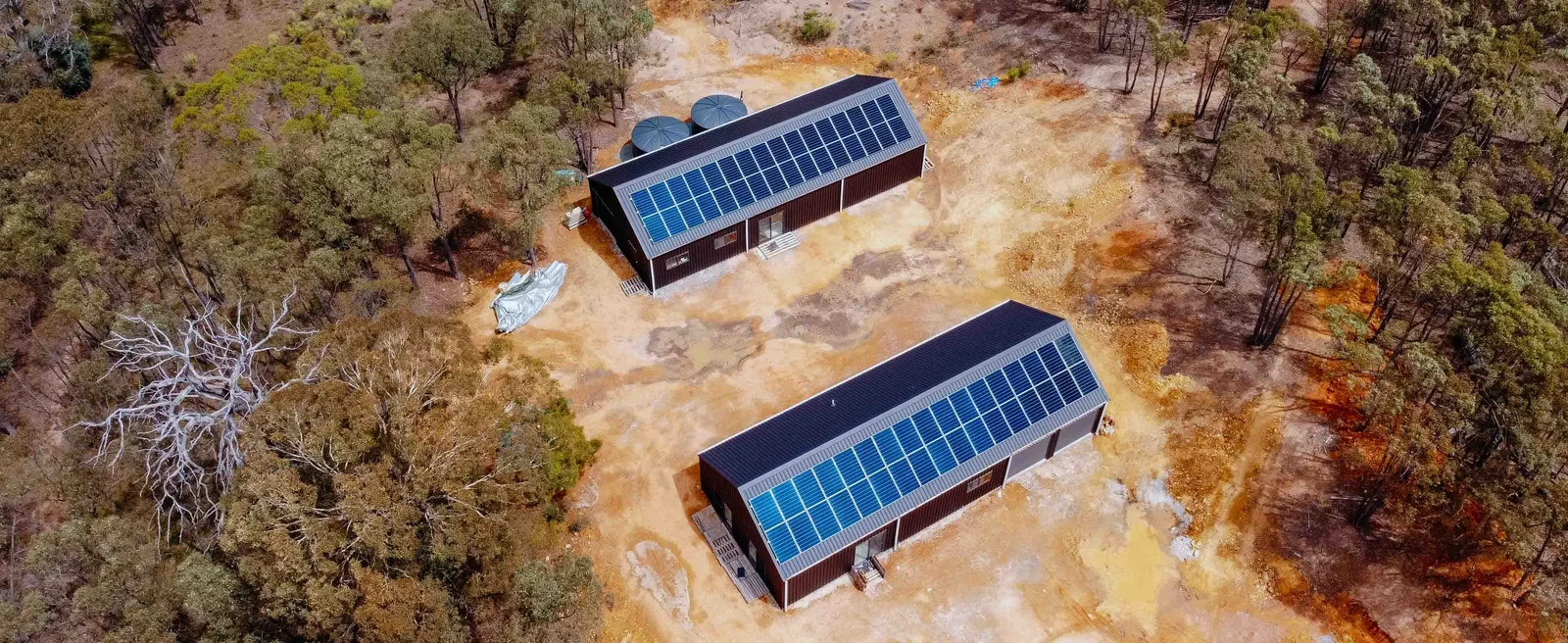
Solar Systems is our core service: full design and installation of grid-connect, hybrid, and off-grid solar systems for homes and businesses across Canberra, Queanbeyan, Batemans Bay and the wider NSW/ACT region. Every system is sized to your actual usage pattern, roof, and budget — not a one-size-fits-all package — using CEC-approved products and CEC-accredited installers throughout.
Residential solar
For homes, that means matching panel and inverter capacity to your household's real electricity usage, roof orientation and shading, and whether you're on a single or three-phase connection. Most NSW and ACT homes land somewhere between a compact 5kW system and a larger 13.2kW+ acreage setup, and it's genuinely common to underestimate how much bigger household loads (EV charging, ducted air conditioning, a pool pump) push that number up — which is exactly why we size against your actual bill and usage, not a rule of thumb. See our residential sizing guide for the detail, or run your own numbers on our savings calculator.
Commercial solar
For businesses, the sizing conversation is different: commercial loads are typically larger and more consistent through the day, three-phase power is the norm rather than the exception, and the payback math often looks better than residential because commercial electricity tariffs and daytime usage patterns tend to align well with solar generation. Our savings calculator includes a dedicated Commercial property tier, reflecting that businesses have genuinely different sizing and load profiles to a household — use it to get a real, tailored estimate rather than a rough per-panel guess.
Real pricing, not a guess
Our on-grid pricing is fitted from our own completed jobs, not an industry-average rate pulled from a comparison site: $824 per kW of installed PV capacity, plus $429 per kWh if you add a battery. Off-grid systems (no grid connection at all) don't compress into a clean per-unit rate the same way — every off-grid job varies too much on load, autonomy and site access to fairly quote that way, so we quote those with a real number after a site visit rather than a fabricated per-kW figure. See our Canberra pricing guide or the off-grid guide for the full breakdown of what drives each.
Our process
- Assessment. We assess your site, energy usage and goals — at no cost, with no obligation.
- Design. We tailor a system setup sized correctly for your needs and budget, not a generic package.
- Installation. Hassle-free execution by CEC-accredited, licensed installers.
- Maintenance. We maintain your system so it keeps performing for years to come — see our solar servicing page for what that ongoing relationship looks like.
What's actually included
A typical grid-connect system has four core parts: solar panels generating DC electricity from sunlight; an inverter converting that DC power into usable AC power for your home and the grid; mounting and racking secured to your roof to Australian wind-loading standards; and a metering/monitoring setup so you can track production day to day. Beyond those four, most installs also include isolators and safety switches required under Australian wiring standards, plus the cabling and switchboard work to connect everything safely. We handle the full design and installation of every part of this as a CEC-accredited installer, so you're not left coordinating separate trades — and if your existing switchboard needs an upgrade to safely handle the new circuits, we assess that during your free site inspection rather than surprising you with it on installation day.
Why Island Solar
- CEC-accredited installers, using CEC-approved products — the standard required for STC rebate eligibility.
- 100+ projects completed across NSW & the ACT.
- 5.0★ on Google from real customers — see our reviews page.
- Real pricing, upfront — no sight-unseen quotes, and no fabricated per-kW numbers for jobs (like off-grid) that don't actually fit that model.
- A workmanship warranty on our own installation work, separate from manufacturer product and performance warranties on panels, inverters and batteries.
How much a system actually generates
A well-positioned system in the Canberra/South-East NSW region typically generates around 1,350 kWh per kW of installed capacity per year — so a 6.6kW system might produce roughly 8,900 kWh annually, and a larger 13.2kW system closer to 17,800 kWh. Whether that translates into meaningful bill savings depends on how much of it you actually use versus export: current published feed-in tariffs sit around 5c/kWh in NSW (IPART) and 6c/kWh in the ACT (Evoenergy network), while retail tariffs are roughly 34c/kWh (NSW, AER Default Market Offer) and 37c/kWh (ACT, ICRC) — so every kWh you use yourself is worth several times more than the same kWh exported. That gap is exactly why system sizing and battery decisions matter more than headline panel wattage; a bigger system that mostly exports at 5-6c/kWh can perform worse financially than a correctly-sized one that maximises self-consumption.
Single vs. three phase — why it affects sizing
Single phase supply is the standard setup for most suburban houses and typically supports inverters up to somewhere around 5–10kW, with the exact ceiling set by your network's export limits rather than one fixed national number. Three phase supply — common on larger homes, rural and acreage properties, and most commercial buildings — spreads the load across three wires instead of one, which is what lets a bigger system get installed without hitting single-phase export restrictions. If you're not sure which supply your property has, it's usually marked on your switchboard or meter, and it's one of the first things we check during your free site inspection, since it directly shapes what system size actually makes sense for your roof and budget.
Ready to talk about your property?
We'll assess your site and energy usage at no cost, with no obligation.