
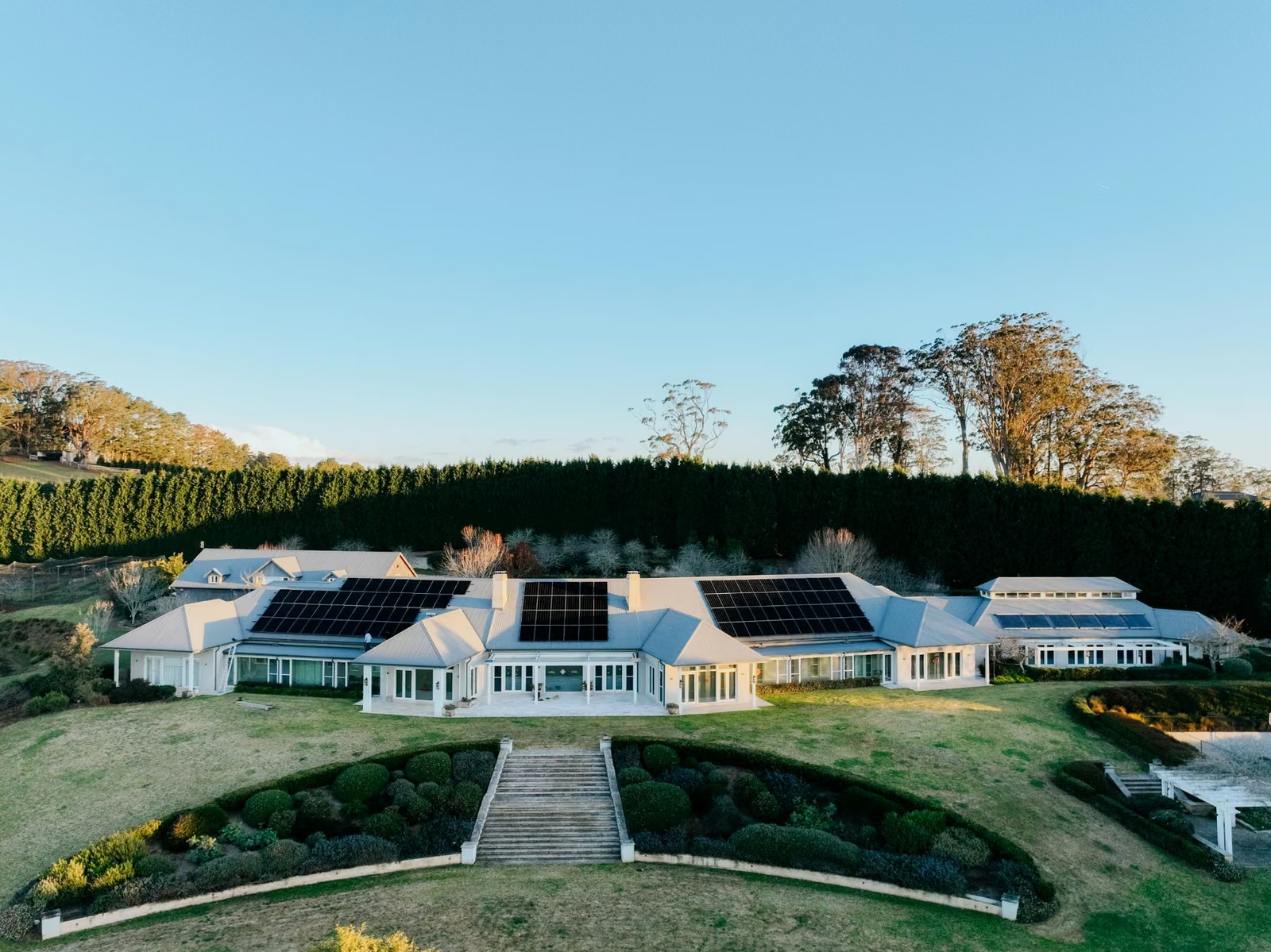
Bungendore sits on the Kings Highway in the Queanbeyan-Palerang region, a short drive from our Crestwood base and close to the ACT border. Because so many residents work in Canberra, it's easy to assume solar here works the way it does over the border. It doesn't, and the differences show up in your connection paperwork, your tariffs and your payback.
This guide covers what's specific to Bungendore. If you're comparing installers in general, read our guide to choosing a CEC-accredited installer first. For the wider region, our Queanbeyan solar guide covers the town next door.
You're on the NSW network, not the ACT one
Electricity in Bungendore is distributed by Essential Energy, the network that covers most of regional NSW. It is not Evoenergy, which runs the ACT network. That one fact drives most of what's different:
- Connection approval goes through Essential Energy. The application, the inverter settings and any limit on how much you can export are set by the distributor for your specific connection.
- NSW tariffs apply. Your retail rates and feed-in tariff are NSW market offers, not ACT ones. Our savings calculator has a NSW setting that uses current NSW benchmark rates.
- ACT-only incentives don't apply to a NSW address. If a neighbour in Canberra mentions a scheme they used, check whether it's open to NSW residents before you count on it.
Export limits are set per connection and can change, so we don't quote a blanket figure. Ask your installer to confirm your site's export limit with Essential Energy in writing, as part of the quote. A system sized on the assumption of unlimited export will overstate its own payback if your connection turns out to be capped.
Cold winters, frost and altitude
Bungendore sits at roughly 700 metres, and frosty winter mornings are normal. People often expect that to hurt solar output. For the panels themselves, it helps: panels are rated at a cell temperature of 25°C and produce slightly more when they're colder.
- Winter output is limited by short days and a low sun, not by cold. Tilt and orientation matter more in winter than at any other time of year.
- Frost is a mounting and safety question, not a panel question. Panels handle it fine. Mounting rails and roof fixings should be specified for the wind loading at your address, which matters on exposed rural sites.
- Heating drives the size of the system. A home heated with reverse-cycle air conditioning has a big daytime winter load. One heated with wood or gas has a much flatter load. That choice changes the right system size more than anything else.
What it costs
We price Bungendore jobs on the same fitted rate we use across our NSW and ACT service area: $824/kW installed for panels, inverter, mounting and commissioning, plus about $429/kWh if you add a battery. These rates come from our own completed jobs. The full method and worked examples are in our pricing breakdown.
| System size | Typical Bungendore property | Indicative cost |
|---|---|---|
| 6.6 kW | Village cottage or smaller home | $5,438 |
| 10 kW | Family home on a village block | $8,240 |
| 13.2 kW | Larger home, or reverse-cycle heating | $10,877 |
| 20 kW | Rural block with a shed, pump or second dwelling | $16,480 |
Federal incentives are applied at the quote stage and change from year to year, so the table doesn't include a rebate figure. Our rebates and STCs guide explains how the schemes work and what to check when you compare quotes.
Village block or rural block?
Bungendore has two very different kinds of property, and they need different designs.
In the village, most homes are on standard residential blocks. The job is usually a roof-mounted grid-connect system, and the main questions are roof orientation, shading from neighbouring trees, and switchboard condition in older homes.
On rural-residential and acreage blocks around the town, more things change:
- A shed roof or a ground mount is often better than the house roof. There's more room, and you can choose the orientation and tilt.
- Cable runs between buildings cost money and lose energy. Where the array goes relative to the loads should be a deliberate decision.
- Pumps, workshops and second dwellings change the load profile. Tell your installer about them before the system is sized.
- Three-phase supply is more common on larger blocks and changes inverter choice and the connection application.
- Outages last longer at the end of a rural line. If you want backup power, say so early. Not every inverter and battery combination can provide it, and our battery storage guide covers when a battery is worth it.
Get a Bungendore quote
Free site inspection, fixed itemised quote, CEC-accredited crew. Bungendore village, the surrounding rural blocks and the wider Queanbeyan-Palerang region.
Five questions to ask before you sign
- Will you confirm my export limit with Essential Energy in writing before I sign?
- Are the tariffs and feed-in rate in your payback figures NSW rates, not ACT rates?
- Is the generation estimate based on a site inspection, including shading, or only on a satellite image?
- Is the mounting system specified for the wind loading at my address?
- If I add a battery, an EV charger or another building later, does this inverter and switchboard leave room for it?
If you want to work through system size yourself first, our residential sizing guide explains how to read your bill. When you're ready, call 0422 292 551 or request a quote and we'll book a site inspection.